
Crude Extracts Versus Pure Compounds in Discovery
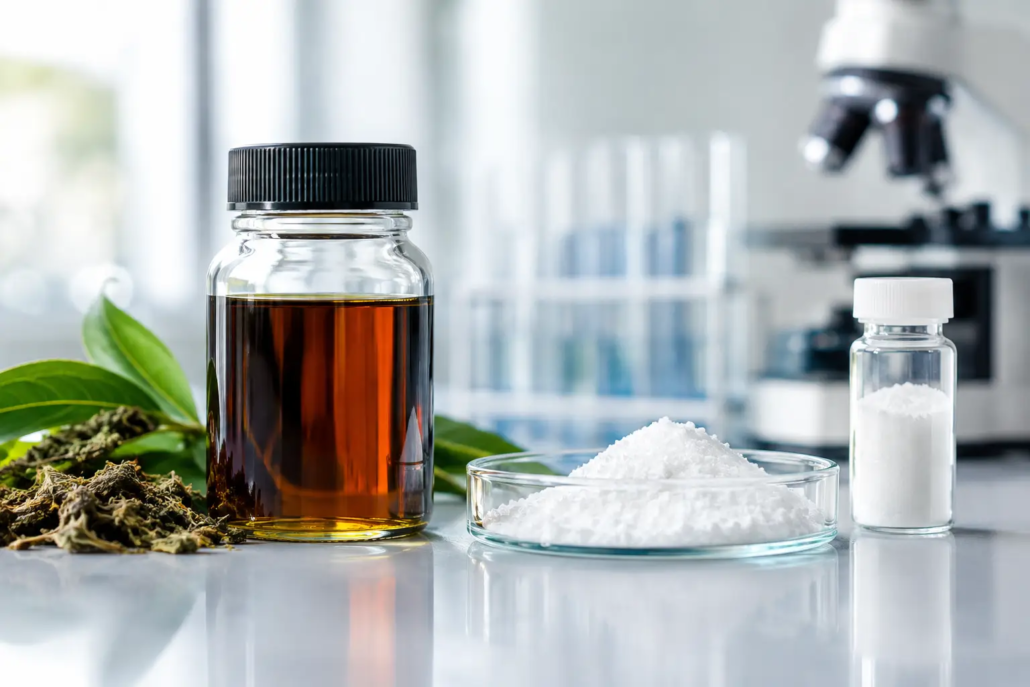
A natural material can produce a compelling biological signal long before researchers know what is responsible for it. That is the central distinction in crude extracts versus pure compounds: an extract may identify a valuable starting point, while a characterized compound may provide the evidence needed to assess whether that starting point can support a development program.
Treating those states as interchangeable can create avoidable scientific and strategic risk. A crude extract is not a failed pure compound, and a pure compound is not automatically a development candidate. Each answers different questions. The discipline of natural-product discovery lies in asking those questions in the appropriate order and advancing only when the available evidence supports the next decision.
Crude Extracts Versus Pure Compounds: Different Evidence States
A crude extract is a complex mixture produced from a biological source, such as a plant, microorganism, marine organism, or other biologically relevant material. Depending on the source and extraction method, it may contain hundreds or thousands of chemical constituents. Its composition can include major metabolites, minor constituents, lipids, pigments, salts, and other materials that may or may not contribute to measured activity.
That complexity is often an advantage at the earliest stage. Screening an extract can reveal whether a source contains chemistry capable of affecting a biological system of interest. It can also identify activity that might be missed if investigators begin with a limited set of already known compounds. Natural materials have historically provided structurally distinctive chemical matter, including scaffolds that can expand the accessible range of biological mechanisms.
A pure compound is a chemically defined constituent isolated from that mixture and characterized to a degree appropriate for its intended use. Purity alone is not sufficient. The compound’s identity, structure, analytical profile, stability, and reproducible biological activity must also be established. For a program considering downstream development, the relationship between chemical identity and observed biological effect becomes central.
The practical difference is therefore not simply mixture versus molecule. It is the level of attribution. An active extract demonstrates that a biological source warrants further investigation. An active, characterized compound can begin to support claims about the chemical entity responsible for an effect, its concentration-response relationship, potential mechanism, and feasibility as a development asset.
What Crude Extracts Can Reveal – and What They Cannot
Crude extracts are valuable research inputs because they preserve chemical diversity. In some cases, their activity may reflect a single potent constituent present at low abundance. In others, several constituents may contribute independently or interact in a manner that changes the measured response. An extract can also contain compounds that improve apparent solubility, alter cellular uptake, or interfere with an assay.
For early discovery, these possibilities are reasons to investigate rather than reasons to overinterpret. A reproducible screening signal across relevant assays, source batches, and experimental conditions can justify bioactivity-guided fractionation. It does not, by itself, establish a mechanism of action, a clinically meaningful effect, or a scalable therapeutic opportunity.
Extract-level results can be especially vulnerable to variability. Species identification, geography, seasonality, growth conditions, collection timing, fermentation parameters, storage, and extraction solvent can all affect composition. Without a documented chain of custody and fit-for-purpose analytical controls, a future batch may not resemble the material that generated the original signal.
Assay artifacts also require disciplined review. Complex samples may produce nonspecific effects through aggregation, fluorescence interference, redox activity, cytotoxicity, detergent-like behavior, or other mechanisms unrelated to the intended target. Orthogonal assays, counterscreens, concentration-response testing, and early analytical characterization help distinguish a signal worth pursuing from one that reflects the limitations of the experimental system.
Bioactivity-Guided Fractionation Connects Signal to Substance
The transition from extract to compound is not a simple purification exercise. Bioactivity-guided fractionation is an iterative evidence-building process. Researchers separate an active extract into fractions, test those fractions, and continue isolating the components associated with retained activity. At each stage, analytical data and biological results should be considered together.
A useful fractionation strategy does more than increase purity. It tracks whether activity follows a specific chemical feature or disappears as the mixture is separated. If activity concentrates in a fraction with a distinct analytical profile, the case for a responsible constituent becomes stronger. If activity declines or shifts unpredictably, the team must consider whether the original effect depended on multiple components, was caused by an unstable constituent, or resulted from an assay-related artifact.
This process also informs prioritization. A highly active fraction may still be a poor program choice if its active constituents are too scarce, chemically unstable, difficult to identify, or incompatible with a plausible supply strategy. Conversely, moderate activity associated with a tractable and structurally novel compound may justify continued investment if the mechanism, selectivity, and intellectual-property position appear promising.
Scientific characterization should proceed in parallel with biological refinement. Chromatographic methods, mass spectrometry, nuclear magnetic resonance spectroscopy, and other fit-for-purpose approaches can establish chemical identity and monitor purity. Re-testing isolated material in the original assay, together with orthogonal validation, is essential. The objective is not merely to obtain a clean sample, but to show that the defined material reproduces the relevant activity.
Why Pure Compounds Improve Development Decisions
A characterized pure compound provides a more reliable unit for decision-making. It enables researchers to establish potency, selectivity, activity across models, and preliminary structure-activity relationships. It can be compared against reference materials, tested in mechanistic studies, and evaluated for liabilities that are difficult to assess in a heterogeneous extract.
Chemical definition also matters for reproducibility. If a program advances, future work must be able to reproduce the material used in pharmacology, toxicology, formulation, and eventually clinical studies. A compound that can be identified, measured, and consistently supplied is far better positioned for this progression than an extract whose composition changes from lot to lot.
For investors and strategic partners, the distinction has direct implications for asset quality. Defined compounds are generally more amenable to composition-of-matter and related intellectual-property strategies, although the strength of any position depends on novelty, prior art, claims scope, and supporting data. They also permit clearer diligence around synthetic access, natural abundance, manufacturing options, impurities, and regulatory expectations.
Yet purity should not be mistaken for readiness. An isolated compound may still have unfavorable physicochemical properties, limited selectivity, unacceptable off-target effects, poor exposure, or an impractical route to supply. Candidate selection requires an integrated review of biology, chemistry, developability, freedom to operate, and the resources required to address remaining uncertainty.
When an Extract May Remain the Appropriate Research Focus
There are circumstances in which an extract or defined multi-component preparation remains relevant. Some research questions concern the activity of standardized natural materials rather than a single molecular entity. In those cases, the central development challenge becomes controlling composition and demonstrating lot-to-lot consistency using appropriate chemical markers and biological specifications.
That pathway is distinct from small-molecule drug development and should not be presented as equivalent. The regulatory strategy, quality framework, manufacturing controls, and clinical rationale may differ substantially. If observed activity depends on a combination of constituents, isolating one compound may not fully represent the original material. Researchers must determine whether the combination is reproducible, scientifically justified, and feasible to control.
The appropriate endpoint therefore depends on the program’s intended use. For a molecular therapeutic candidate, isolating and characterizing the active principle is commonly necessary. For a standardized complex material, the program must instead establish a defensible definition of the preparation and its relevant quality attributes. Neither route eliminates the need for rigorous validation.
A Staged Framework for Candidate Selection
The most productive way to view crude extracts versus pure compounds is as a staged progression of evidence, not a binary choice. Extract screening can broaden opportunity. Fractionation can test whether that opportunity is chemically attributable. Compound identification and characterization can establish whether the resulting entity merits development-oriented work.
At each transition, predefined criteria reduce the risk of advancing on enthusiasm alone. These criteria may include reproducible activity, confirmation in secondary assays, selectivity or target relevance, chemical identity, purity, stability, supply feasibility, and a preliminary assessment of intellectual-property and regulatory considerations. The criteria should be program-specific because the evidence needed for an antimicrobial lead differs from that needed for an oncology, inflammation, or metabolic disease program.
This approach can also improve capital allocation. Rather than committing extensive resources to every screening hit, teams can use increasing evidence requirements to focus effort on programs with a clearer path to differentiation and execution. Negative results are informative when they identify instability, nonselective activity, inadequate supply, or a lack of chemical tractability early enough to redirect resources.
For GenBio, this evidence-refinement model places natural-product diversity within a disciplined discovery and development planning framework. The goal is not to make broad claims from an initial extract signal. It is to create a traceable basis for deciding which materials deserve further study and which compounds may warrant selection as development candidates.
A promising natural source becomes more valuable as uncertainty is reduced with care. The next useful question is rarely whether an extract or a pure compound is inherently better. It is which evidence is needed now to make the next development decision responsibly.